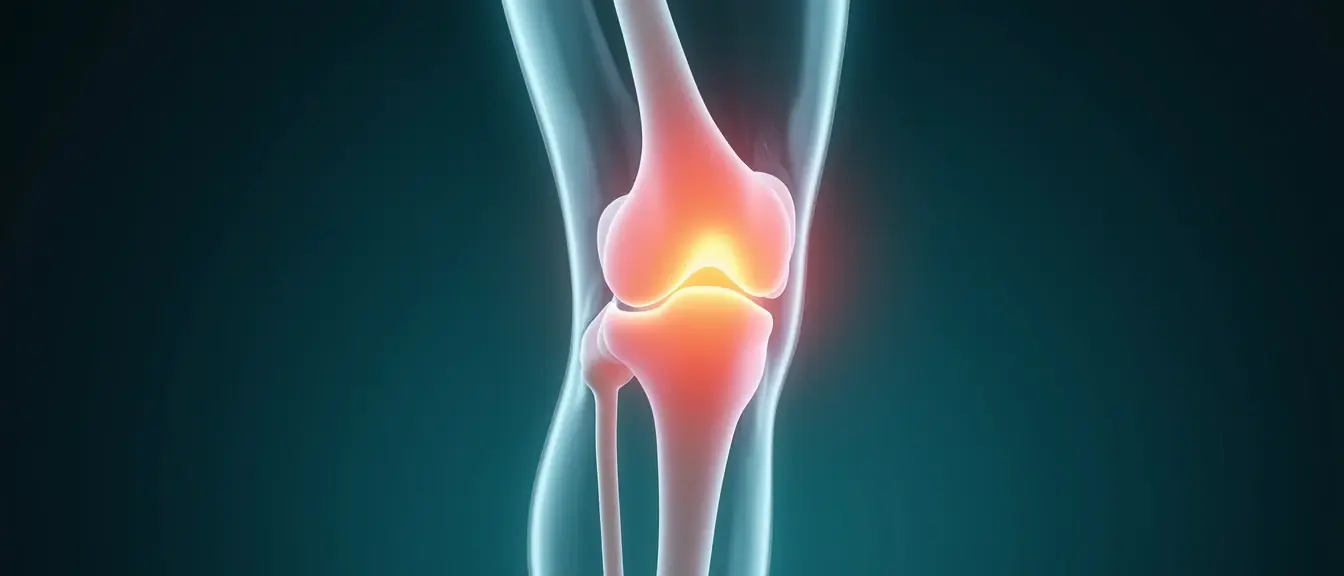
Quick answer. Knee osteoarthritis is long-term joint pain and stiffness that cannot be cured but can often be eased. Strengthening exercise and weight loss, if needed, are the core treatments, with pain relief as support. Knee replacement is considered when symptoms badly affect daily life and other treatments have not helped.
What knee osteoarthritis is
Osteoarthritis is a long-term condition in which the cartilage covering the ends of bones breaks down, leaving joints painful and stiff. It affects the entire joint and the tissues around it. There is no cure, but it does not always get worse and can sometimes improve. When it does progress, the pace varies from person to person.
It is common in India. A 2025 review of 14 community studies with 5,029 older people estimated that 47 percent of elderly people in India have knee osteoarthritis. The studies varied widely, so treat this as a rough figure.
Who is more likely to get it
Risk factors include older age, being female, obesity, a past joint injury, a family history, and joint conditions such as rheumatoid arthritis or gout. WHO also lists repetitive stress from work or sport, and metabolic conditions such as diabetes.
Common symptoms
- Pain and stiffness, often worst on hills or stairs.
- Stiffness after rest, with morning stiffness that is absent or lasts under 30 minutes.
- A grating or crackling feeling, some swelling or tenderness.
- A knee that gives way or is hard to straighten, and weaker thigh muscles.
Symptoms can flare up and settle. Over time, both knees are usually affected, unless a single injury caused the problem.
When to get checked quickly
Seek prompt medical advice for severe pain, a knee you cannot move or put weight on, a badly swollen or misshapen knee, or a knee that locks. High fever or chills with redness or heat around the knee can be a sign of infection, so get seen the same day.
How it is diagnosed
Often no scan is needed. NICE, the UK’s guideline body, advises diagnosing osteoarthritis without imaging in people aged 45 or over with activity-related joint pain and little or no morning stiffness. It advises against routine imaging unless something unusual suggests another diagnosis.
- Examination: the doctor checks for grating, swelling, tenderness and how far the knee moves.
- X-ray: useful in some cases. It may show narrowed joint space and bone spurs, but some people have these changes without any symptoms, so the picture alone does not decide your treatment.
- Blood tests: these do not diagnose osteoarthritis, but can rule out rheumatoid arthritis or gout.
- MRI: routine imaging is not advised. Ask why it is being advised, and how the result would change your treatment.
Treatment should be guided by your symptoms and how well you can move, not by how the scan looks.
Treatment options, in the usual order
Exercise and weight
NICE calls therapeutic exercise and weight management, if appropriate, the core treatments. Exercise should be tailored to you, such as muscle strengthening and general fitness. A physiotherapist can plan this and supervise the first sessions.
Pain may increase when you start. NICE says regular exercise still helps the joint in the long term, and sticking with it reduces pain. Low-impact choices include swimming, walking and cycling.
If you are overweight, any weight loss is likely to help, and losing 10 percent of body weight is likely to be better than 5 percent.
What the guidance says about other treatments
The table sets out NICE guidance from the UK, the closest detailed national guideline we could read. Your doctor may weigh things differently for you.
| Treatment | What NICE says |
|---|---|
| Anti-inflammatory gel or cream (topical NSAID) | Offer for knee osteoarthritis. Use the lowest effective dose for the shortest possible time |
| Anti-inflammatory tablets (oral NSAID) | Consider if creams do not work, after weighing stomach, kidney, liver and heart risks, with a stomach-protecting medicine |
| Paracetamol and weak opioids | Not routinely, except for infrequent short-term use. There is no strong evidence of benefit for paracetamol |
| Strong opioids | Do not offer. The risks outweigh the benefits |
| Glucosamine | Do not offer. There is no strong evidence of benefit |
| Steroid injection into the knee | Consider when other medicines do not help, or to support exercise. Relief lasts only 2 to 10 weeks |
| Hyaluronan (gel) injection | Do not offer |
| Walking stick or other aid | Consider |
| Insoles, braces, tape | Not routinely, only for instability or abnormal loading when exercise alone is not enough |
| Manual therapy | Only alongside exercise |
| TENS, ultrasound, laser, interferential and other electrotherapy | Do not offer. There is not enough evidence of benefit |
| Acupuncture or dry needling | Do not offer |
| Knee washout or trimming by arthroscopy | Do not offer |
Other bodies do not always agree on the details. MedlinePlus says acupuncture, yoga and tai chi may ease pain for some people. WHO says evidence for stem cell therapy is insufficient. If someone offers a treatment that is not listed here, ask what evidence supports it and what it will cost in total.
Before taking painkillers regularly, talk to your doctor, especially with kidney, stomach or heart problems, or if you are on other long-term medicines.
When knee replacement makes sense
NICE says to consider referral when symptoms substantially affect quality of life and non-surgical treatment has not worked or is unsuitable. The decision should rest on clinical assessment, and people should not be excluded because of age, sex, smoking, other conditions or weight, although these can change the risks.
The American Academy of Orthopaedic Surgeons lists severe pain limiting walking and stairs, pain at rest, ongoing swelling, a bowed knee, and little help from other treatment as common reasons. Recommendations are based on pain and disability, not age.
What to expect
- Result: most people get much less pain and better daily function, but the knee will not let you do more than you could before arthritis. Running and jumping are generally discouraged.
- Hospital stay: in the UK, most people go home within 1 to 4 days, walking with crutches.
- Recovery: physiotherapy starts early. Many people return to work at about 6 to 12 weeks, depending on the job, and full recovery can take several months or longer.
- Risks: blood clots, wound infection, nerve or vessel damage, and ongoing pain or stiffness. Infection occurs in fewer than 2 percent of patients, according to AAOS.
- Lifespan: the NHS says a replacement typically lasts about 25 years, and AAOS says over 90 percent still work well at 15 years.
- Kneeling may be uncomfortable, though not harmful. If floor sitting, squatting or an Indian-style toilet is part of your day, raise this with your surgeon before surgery.
Other operations such as osteotomy, which reshapes the shin bone, may suit some people. Partial replacement is another option for some, with a generally shorter recovery than a total replacement.
A note on implant prices in India
India’s drug price regulator, the NPPA, has set ceiling prices for knee implants since 2017. The last extension we could confirm runs to 15 November 2026 or until further orders, so check whether it has been renewed. Ask the hospital for a written estimate that lists the implant separately.
Who treats knee osteoarthritis
A general physician or physiotherapist often starts with exercises. An orthopaedic doctor sees knees that stay painful, swell or lock, and discusses surgery if it comes to that. Morning stiffness across several joints may need a different check for inflammatory arthritis, so mention it. Our specialist finder and find a doctor pages can help you locate someone.
What to ask your doctor
- Is this osteoarthritis, or could something else be causing my pain?
- Do I need an X-ray or MRI, and how would the result change the plan?
- Which exercises should I do, and can a physiotherapist get me started?
- Is a painkiller safe with my kidneys, stomach, heart and other medicines?
- How long should I try this before we review it?
- If you are advising an injection or a supplement, what benefit can I expect, and for how long?
- If you are advising surgery, what happens if I wait? What are my risks, given my age and health?
- How many of these operations does this team do, and what does the full estimate include?
Common questions
Should I stop walking and rest my knee?
Usually not. NICE says regular exercise is beneficial in the long term, even if it causes some discomfort at first. Follow the plan from your doctor or physiotherapist, and get prompt advice for severe pain or a knee that will not take weight.
Do glucosamine or other supplements help?
NICE does not recommend glucosamine, citing no strong evidence of benefit, and WHO says guidelines do not consider it effective. MedlinePlus lists glucosamine and chondroitin among options some people try. Ask your doctor before spending on them.
Am I too old or too young for a knee replacement?
Age alone does not decide it. Most patients are between 50 and 80, but the choice rests on pain and disability. Your overall health and the risks should be part of the discussion.
Will a knee brace fix it?
NICE does not advise braces routinely, and MedlinePlus says to use them only when a doctor or therapist recommends it, since poor use can cause harm.
Sources
- NHS: Osteoarthritis (checked 2 Nov 2026)
- WHO: Osteoarthritis fact sheet (checked 2 Nov 2026)
- MedlinePlus: Osteoarthritis (checked 2 Nov 2026)
- Daniel RA et al. Prevalence of knee osteoarthritis among elderly persons in India. J Family Med Prim Care, 2025 (checked 2 Nov 2026)
- NHS: Osteoarthritis symptoms (checked 2 Nov 2026)
- NICE guideline NG226: Osteoarthritis in over 16s, recommendations (checked 2 Nov 2026)
- NHS: Knee pain (checked 2 Nov 2026)
- NHS: Knee replacement, alternatives (checked 2 Nov 2026)
- American Academy of Orthopaedic Surgeons, OrthoInfo: Total knee replacement (checked 2 Nov 2026)
- NHS: Knee replacement, recovery (checked 2 Nov 2026)
- NHS: Knee replacement, risks (checked 2 Nov 2026)
- Medical Dialogues: report of NPPA order S.O. 5190(E) on knee implant ceiling prices, 17 Nov 2025 (checked 2 Nov 2026)